My research connects questions that are often separated: how clinicians use new tools, how expertise develops, and how organizations can turn evidence into responsible practice.
01
AI in clinical work
AI tools become consequential when they enter real clinical environments. I study how clinicians adopt these tools, how they redistribute documentation and cognitive work, and what evidence leaders need to judge their effects.
2026 Annals of Emergency Medicine
Ambient Artificial Intelligence Scribe Adoption and Documentation Time in the Emergency Department
Carl Preiksaitis and colleagues described real-world adoption of an ambient AI scribe and compared documentation time and note characteristics using electronic health record audit logs.
Medical education has to prepare clinicians to work with AI while keeping the reasoning that supervisors need to see visible. This work moves from mapping the field to practical guidance for programs and teachers.
Article series
AI Teaching Rounds
My series in the Journal of Graduate Medical Education examines the everyday decisions educators face as AI enters training—from supervising resident use to deciding how much to trust AI in teaching and assessment.
Opportunities, Challenges, and Future Directions of Generative Artificial Intelligence in Medical Education: Scoping Review
Carl Preiksaitis and Christian Rose synthesized the early literature and identified critical evaluation, assessment, and human–AI interaction as priorities for study.
Clinical data can make parts of work and learning visible at a scale that observation alone cannot. I direct SIERRA, the Stanford Integrated Emergency Research Repository and Archive, to support collaborative research in emergency medicine. My work in educational measurement asks what clinical documentation can tell us about the development of expertise.
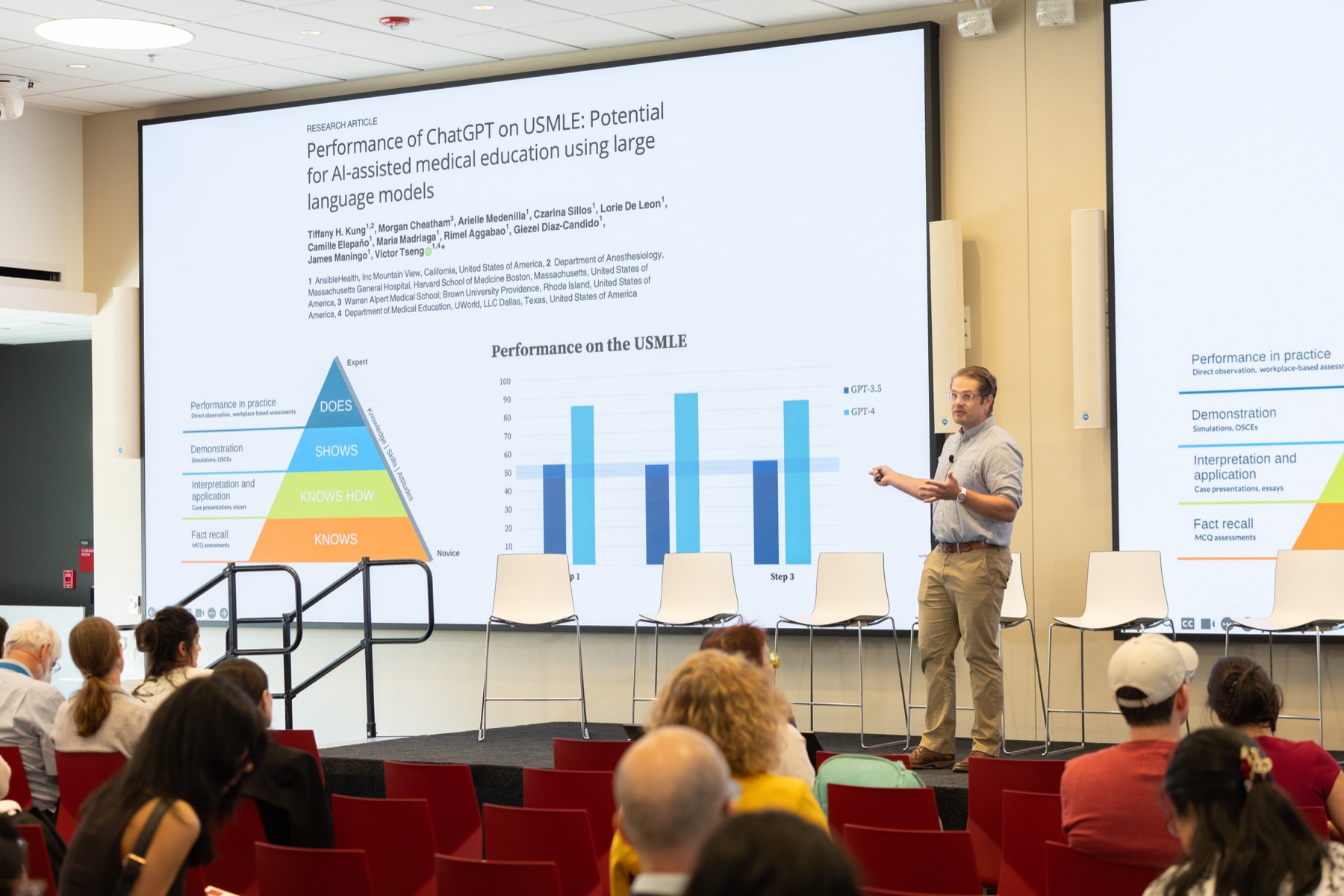
How can educators assess clinical judgment when AI helps produce the work? This session explores what faculty should observe, how supervision should adapt, and which parts of learning need to remain human.
IU School of Medicine · Annual Program Directors Meeting · 2026